The NHS in Glasgow won’t remove a mole just because you don’t like how it looks. It removes a mole when a doctor thinks it could be skin cancer, and then it’s free and sent to a lab for testing. If the mole is harmless and you want it gone for cosmetic reasons, you’ll need to pay a private clinic.
Whichever route you take, get the mole checked first. This guide explains when the NHS will remove a mole, how private removal works, what to ask a clinic before you pay, and how a mole check at Carmunnock Pharmacy fits in.
The short version
- Harmless moles aren’t removed on the NHS for cosmetic reasons. NHS Scotland guidance tells GPs not to refer moles for cosmetic removal.
- Suspicious moles are removed on the NHS. If your GP thinks a mole could be melanoma, you’ll be referred urgently to a hospital skin clinic.
- Private removal is the route for a harmless mole you’d like gone. It’s usually a shave or a small cut under local anaesthetic.
- Check the mole before you pay to remove it. A mole that turns out to need medical attention should go through your GP, not a cosmetic clinic.
- Carmunnock Pharmacy doesn’t remove moles. We offer a private mole check, reviewed by a UK consultant dermatologist, usually within 48 hours.
Can I get a mole removed on the NHS in Glasgow?
Only if there’s a medical reason. NHS Scotland’s referral guidance for GPs says not to refer patients with moles for cosmetic removal, and that a harmless skin lesion won’t be removed by a hospital for cosmetic reasons alone.
A mole is likely to be looked at by a specialist when:
- Your GP isn’t sure the mole is harmless
- The mole has signs that could mean skin cancer
- It causes a real problem, for example it keeps getting caught and bleeding
In the rare cases where a harmless mole causes a serious problem, there’s a separate exceptional referral process, and your GP decides whether you qualify. Disliking how a mole looks doesn’t count.
Signs a mole needs checking first
See your GP, or get the mole checked, if:
- It has changed size, shape or colour
- It’s painful or itchy
- It’s inflamed, bleeding or crusty
- It’s new and hasn’t gone away after a few weeks
- It has uneven edges or more than 2 colours
If a mole is bleeding or changing quickly, contact your GP straight away rather than booking a private check or a cosmetic removal. Our guide to skin cancer screening in Glasgow explains the ABCDE signs in more detail.
How are moles removed privately?
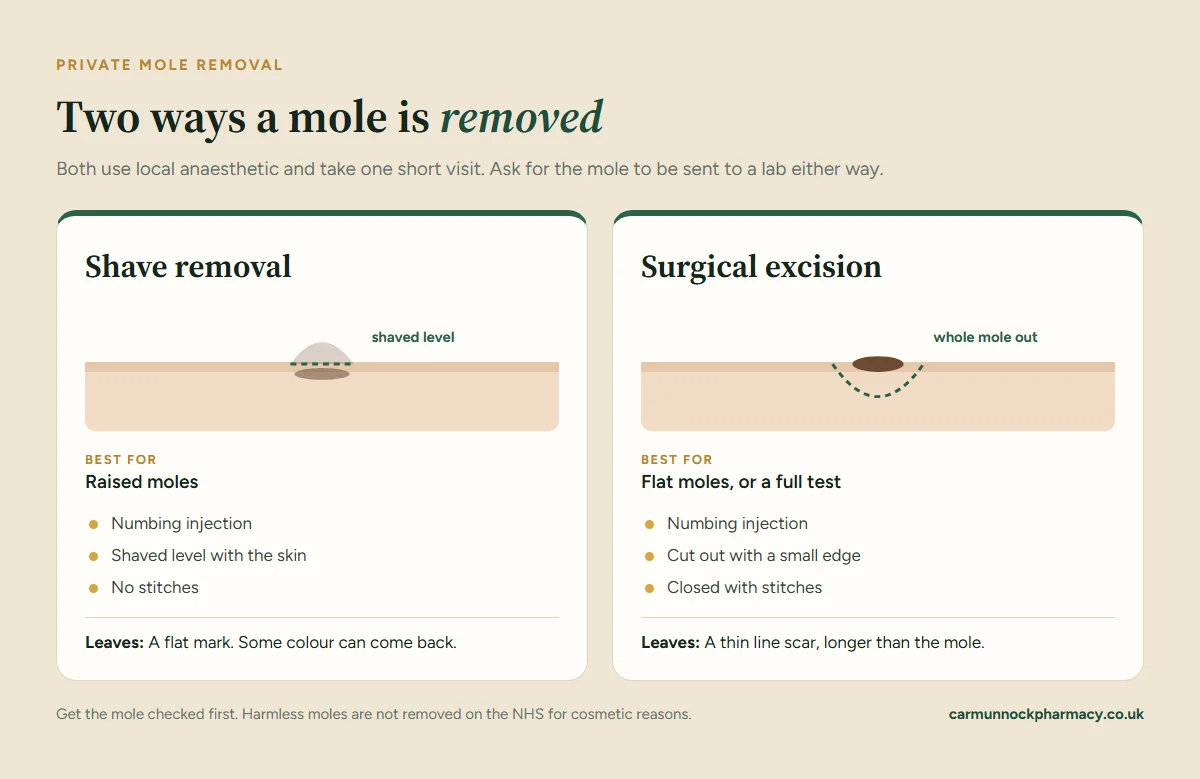
Private clinics in Glasgow use two main methods. A doctor or skin specialist examines the mole first and recommends one.
| Method | Best for | What happens | What it leaves |
|---|---|---|---|
| Shave removal | Raised moles | The skin is numbed and the mole is shaved level with the skin. No stitches | A flat mark, often pale or pink at first. Some colour can come back |
| Surgical excision | Flat moles, or any mole a doctor wants to test fully | The skin is numbed, the whole mole is cut out with a small edge of skin and the wound is stitched | A thin line scar, usually longer than the mole itself |
Both are short procedures under local anaesthetic, and you go home the same day. You may need to keep the area dry for a day or two and go back to have stitches out.
Should a removed mole be tested?
Yes. Ask the clinic to send the mole to a lab (histology) as standard. It’s the only way to be certain it was harmless. Be wary of anywhere that offers to burn, freeze or laser a mole off without testing it, because that leaves nothing to test.
What to ask a private clinic before you pay
- Who will remove it? A doctor or a qualified skin specialist should examine the mole and do the procedure.
- Will it be sent to a lab? Testing should be included, or at least offered.
- What’s the full price? Ask whether the consultation, the removal, the lab test and any follow-up are all included.
- What scar should I expect? Ask to see the likely result for the method they recommend.
- What happens if the result isn’t clear? They should tell you how you’ll get the result and what happens next.
Never try to cut, tie off or burn a mole yourself, or use mole removal creams sold online. They can cause infection and scarring, and if the mole was a melanoma, removing it at home can hide it and delay diagnosis.
How much does mole removal cost in Glasgow?
Private prices vary with the method, the size and number of moles, where they are on your body and whether lab testing is included. Ask for a written quote covering everything before you book. The NHS says private removal may be expensive, so it’s worth knowing the mole is harmless before you pay.
Getting a mole checked at Carmunnock Pharmacy
If you’re thinking about having a mole removed, a check is a sensible first step. It tells you whether the mole needs medical attention through your GP or whether cosmetic removal is an option.
- Come into the pharmacy. No GP referral is needed.
- We take a magnified photo of the mole with a dermatoscope, the same type of device used in dermatology clinics, and note a short history.
- A UK consultant dermatologist reviews it and sends back a report, usually within 48 hours, with reassurance or a recommended next step.
It’s a photo-based check, not a diagnosis, biopsy or removal, and it doesn’t replace your GP. If the dermatologist has any concern, you’ll be told clearly what to do next, which may include an urgent GP referral. Read more about our mole and skin check, book a mole check or contact us for the current price.
We’re at 15-17 Busby Road, Carmunnock, Glasgow G76 9BP, on the south side of the city, close to Busby, Clarkston, Castlemilk and East Kilbride.
Mole removal FAQs
Does the NHS remove moles in Scotland?
Only for a medical reason, mainly when a doctor thinks the mole could be skin cancer. NHS Scotland doesn’t remove harmless moles for cosmetic reasons.
Can a pharmacy remove a mole?
Carmunnock Pharmacy doesn’t remove moles. We offer a mole check, where a consultant dermatologist reviews a dermatoscope photo of the mole and tells you whether it needs further action.
Will mole removal leave a scar?
Usually, yes, but it’s often small. Shave removal leaves a flat mark, and surgical excision leaves a thin line scar. Ask the clinic what to expect for your mole.
Can a mole grow back after it’s removed?
Some colour can come back after shave removal, because part of the mole can sit below the skin. Surgical excision removes the whole mole, so it’s less likely to come back. If a removed mole comes back and changes, get it checked.
Should I get a mole checked before having it removed?
Yes. A check tells you whether the mole should be dealt with through your GP before you pay for cosmetic removal.
Sources: NHS Scotland Right Decisions, benign skin lesions referral guidance and NHS, Moles.